
This week I have thought about memes in ways I never have before. What I mean by this is I normally look at memes as a way to laugh and relate to others around me. However, through learning about digital activism and the ways people thought about the recent 10 year challenge has opened up my mind to the possibilities and actual issues that memes have on our society.
Digital activism is defined in a scholarly article titled “The Era of Digital Activism” as “the best term to discuss all instances of activism that use digital network infrastructure (1)” For example, in our past we have seen these as a way to campaign for human rights, for upcoming political elections, and other issues that occur in our political war. The issue with digital activism is that a lot of people do not think it is actually doing anything. Below, I have attached two memes that are about the fact that digital activism does not do much for the political world as people think.
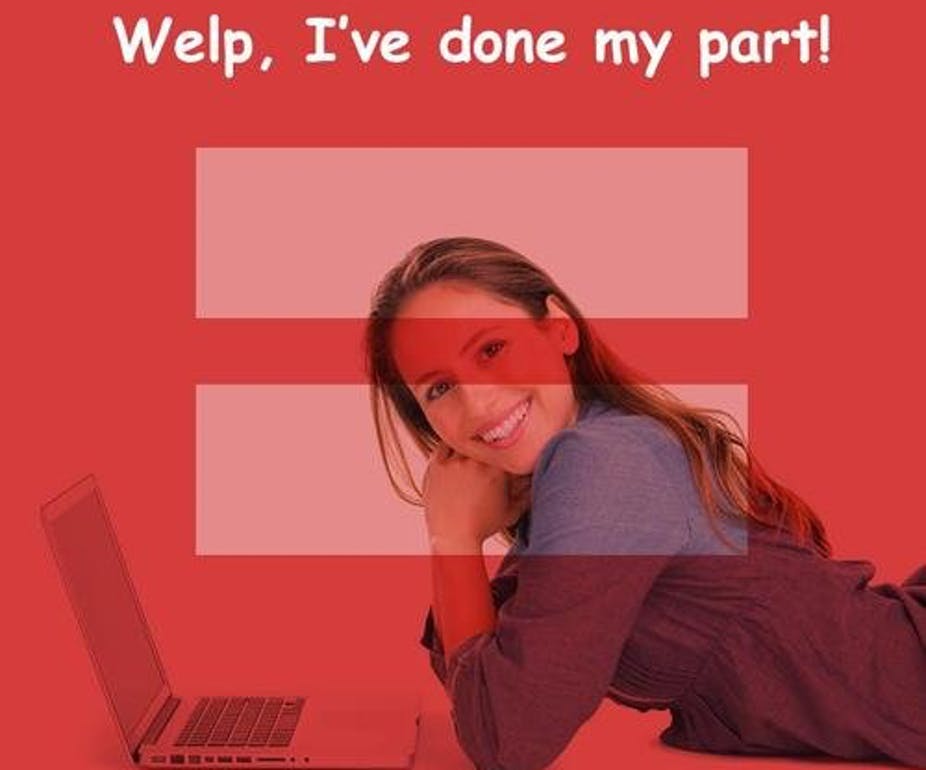
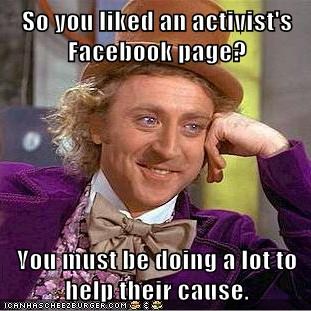
The first meme shown above is about the human rights campaign and is also talked about in the scholarly article titled “In defense of slaktivism: The Human Rights Campaign Facebook logo as digital activism (2).” This article fights my statement above and tries to prove memes like this wrong because they defend how the fact that people changed their facebook profile pictures and became more aware of the Human Rights Campaign led to it succeeding. The article states that, “Part of that success is driven by the clear replication of the HRC logo (the red color and the equal signs remain intact in the three examples above) with the inclusion of popular culture examples — examples that are likely to appeal to the audience because of their familiarity.” As the article continues, it talks more about the idea of slacktivism and how these memes may not be as successful as we think.
One of the biggest issues that I learned about through this article was that some people use this popularity of memes to make a political change in a bad way. The article says, “In an ideal world, we would be able to support only those causes that were clearly and overtly good.” Sadly, opinions between people differ and memes and digital activism is used in a negative light and many become offended. However, like most things in life you can look at the situation with the glass half empty or half full.
Another topic that we addressed this week regarded the 10 year Meme Challenge that has recently been a hit on social media. When I first read the article about how this challenge could actually be Facebook’s way of doing facial recognition tests over the years. It was interesting to see that even memes that are supposed to be a funny moment for people to share are now being tested and analyzed as the government and applications invading our privacy even more. It is wild to me that our society is so on edge about all of these things when in my opinion, memes are just here for people to have a good time and relate to each other.
Bibliography
- Sivitanides, Marco, and Vivek Shah. “The Era of Digital Activism.” Education Special Interest Group of the AITP4, no. 1842 (2011): 1-8. https://pdfs.semanticscholar.org/ebb2/38b876ccfaf461c3b829261936ef0f6fd33d.pdf.Sivitanides, Marco, and Vivek Shah. “The Era of Digital Activism.” Education Special Interest Group of the AITP4, no. 1842 (2011): 1-8. https://pdfs.semanticscholar.org/ebb2/38b876ccfaf461c3b829261936ef0f6fd33d.pdf.
- Vie, Stephanie. “In Defense of “slacktivism”: The Human Rights Campaign Facebook Logo as Digital Activism.” First Monday 19, no. 4 (April 7, 2017).
 Jaymi Zimmerman Abroad